
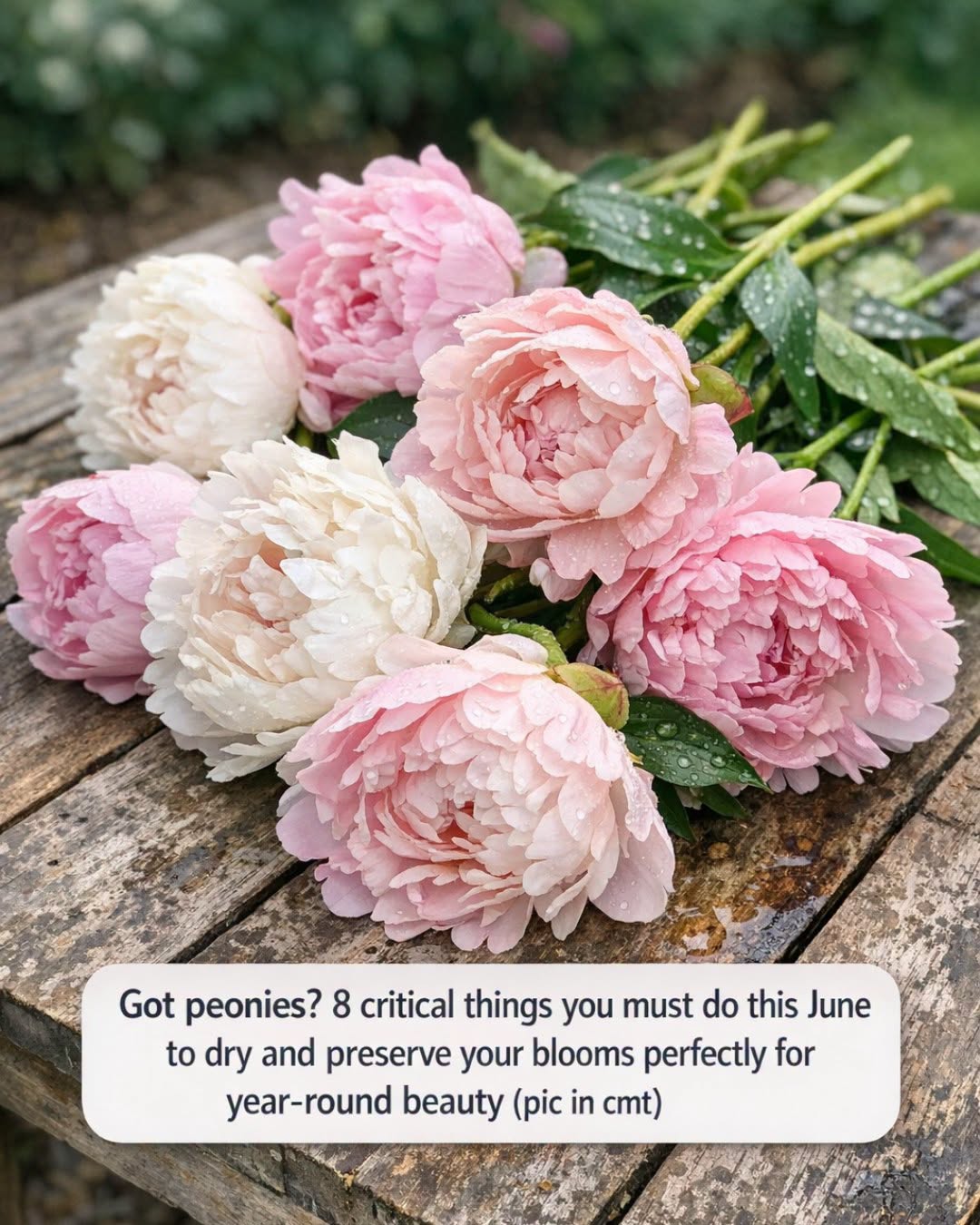
Every June, my peonies seem to reach that maddeningly beautiful stage where they are almost too lovely to leave in the garden and too fleeting to ignore. I’ve cut armfuls on humid mornings in the Mid-Atlantic, carried them into my kitchen in old enamel buckets, and learned the hard way that preserving peonies is all about timing. Wait even three or four days too long, and those lush, cloudlike blooms that looked perfect outdoors can collapse, brown at the edges, or dry into a papery mess.
If you want peonies that still look graceful in December, not just shriveled souvenirs, June is the month to act. Below, I’m walking you through the essential steps I use to dry and preserve peonies successfully, from choosing the right stage of bloom to controlling humidity, wiring stems, storing petals, and avoiding the common mistakes that ruin color and shape. Although the headline says eight, I’m giving you a fuller system so you can actually get reliable, year-round results.
1. Cut peonies at the correct stage, not when they are fully open
The single biggest mistake I see is waiting until a peony is dinner-plate open and ruffled to the center. For drying, that is usually too late. I cut most blooms at the “marshmallow stage,” when the bud feels soft if you gently squeeze it, the outer petals have loosened, and you can see the flower’s true color, but it has not completely flattened.
On most herbaceous peonies, that means a bloom diameter of roughly 2 to 4 inches at cutting time, depending on the variety. White and blush peonies often need to be cut slightly tighter than deep pink or red types because pale petals bruise and brown faster. If I’m planning to air-dry whole stems, I cut earlier than if I’m preserving petals in silica gel, because silica can support a slightly more open flower.
2. Harvest in the coolest part of the day
June heat changes everything. I cut peonies between 6:00 and 9:00 a.m., after the dew has dried but before the sun is high. If you harvest at 2:00 p.m. when the garden is 82°F and humid, petals are already losing moisture unevenly, and flowers are more likely to shatter during handling.
Bring a clean bucket with 3 to 4 inches of cool water if you are conditioning stems before deciding which blooms to preserve. If you are hanging stems to dry immediately, keep them shaded and indoors within 15 to 20 minutes of cutting. I never leave peonies in a hot car or on a porch table “just for a bit.” Even half an hour in trapped heat can soften the petals too much for good preservation.
3. Choose the right flowers and reject flawed ones early
Not every peony deserves the drying rack. The best candidates are blooms with strong outer guard petals, no insect-chewed edges, no rain spotting, and no tan or translucent patches. Once a petal starts browning, drying usually intensifies the damage rather than disguising it.
I sort mine into three groups: whole flowers for bouquet display, medium-quality blooms for petal confetti or potpourri, and damaged flowers for compost. This sounds ruthless, but it saves time and silica gel. A 5-pound container of silica gel can cost $25 to $40, and I’d much rather spend it on a nearly perfect ‘Sarah Bernhardt’ or ‘Festiva Maxima’ bloom than on one that already has botrytis marks.
4. Strip extra foliage and prepare stems properly
Before drying whole peonies, remove all but the top 1 or 2 leaves, and often I remove every leaf entirely. Foliage holds moisture far longer than petals and can cause mold if bundled too thickly. I recut stems to 8 to 12 inches for air drying, which is a manageable length for hanging and later arranging.
Use sharp pruners or florist snips and make a clean angled cut. If a stem feels especially juicy or thick, let it rest on a towel for 20 to 30 minutes before hanging so the cut end is not actively wet. For very heavy double peonies, I often insert a 22- or 24-gauge florist wire through the calyx once dried, because the original stem rarely stays strong enough for long-term display.
5. Decide which preservation method fits your goal
There is no single “best” way to preserve peonies. The method depends on whether you want natural, vintage-looking dried stems or more lifelike flowers with rounded shape. I use three main methods: air drying, silica gel drying, and petal drying.
Air drying is simplest and cheapest, and it works best for looser, less fully double flowers. Silica gel gives the best shape retention for large romantic peonies, especially if you want them for wreaths, shadow boxes, or winter arrangements. Petal drying is ideal when a bloom is too full to preserve whole but the color is still gorgeous. If you choose the method before you start cutting, you’ll harvest at the right stage and avoid wasted flowers.
6. Air-dry whole peonies in small bunches with controlled airflow
If you are air drying, bundle only 2 to 3 stems together with twine, a rubber band, or a soft plant tie. More than that, and the flower heads trap moisture. Hang them upside down in a dark, dry room with temperatures around 60°F to 75°F and relative humidity ideally below 50%.
A spare closet, dry attic room, or air-conditioned guest room works far better than a garage in a humid climate. I leave at least 4 inches between bunches so air can move around them. Drying usually takes 10 to 21 days, depending on bloom size and humidity. You’ll know they’re ready when petals feel papery and the base of the flower no longer feels cool or flexible.
Darkness matters. Bright light bleaches pink peonies quickly, and whites can yellow. I learned this after hanging a pale blush variety near a sunny laundry room window; in two weeks it had turned from shell pink to the color of old tissue paper.
7. Use silica gel if you want the fullest shape and best color
For peonies with deeply layered petals, silica gel is the method I trust most. Pour 1 to 2 inches of silica gel into an airtight plastic or metal container. Trim the stem to about 1 inch, set the flower upright, and gently spoon silica between the petals until the entire bloom is supported. Do not dump it all on at once. That crushes the center.
Choose a container at least 2 inches wider than the bloom and deep enough that the flower sits without pressing against the lid. Seal the container tightly. Most peonies dry in silica within 5 to 7 days, though very large double blooms can take 8 to 10 days. I check one test bloom at day 5 rather than opening every container repeatedly.
When removing the flower, tip the container slowly and use a soft artist’s brush to coax silica from the petals. Save the silica gel afterward; many brands can be reused after drying it out according to package directions, often in a low oven. This method costs more upfront, but the result is dramatically better if you want recognizable peony form.
8. Dry petals separately for bowls, sachets, and confetti
Some peonies are simply too large or loose to preserve whole attractively, especially after rain. In that case, I pluck the cleanest petals and dry them flat in a single layer on a mesh screen, drying rack, or parchment-lined tray. Never pile fresh petals more than 1 layer deep.
Keep them in a dark room with a fan nearby, not blowing directly on them. They usually dry in 4 to 7 days. If your home is humid, a dehydrator set to its lowest setting, around 95°F to 105°F, can speed things up to 6 to 12 hours. I check every 2 hours because petals can curl or overdry surprisingly fast.
These dried petals are lovely in glass bowls, drawer sachets, handmade paper, or wedding keepsakes. They also let you preserve fragrance better than many whole-flower methods, though peony scent still softens noticeably over time.
9. Keep humidity low or you risk mold, browning, and collapse
June preservation is really a moisture-management exercise. If indoor humidity creeps above 55% to 60%, peonies dry too slowly and become prone to gray mold, petal spotting, and misshapen drooping. In my region, that often means running a dehumidifier in the room where I’m drying flowers, especially during rainy stretches.
A small home dehumidifier can pull 20 to 35 pints of water from the air per day, and that makes a visible difference. If you don’t have one, choose the driest air-conditioned room in the house and keep doors closed. Avoid basements unless they are fully climate-controlled. They may feel cool, but many sit at 65% humidity or higher in early summer, which is not ideal for peonies.
10. Reinforce dried blooms for arranging before they become brittle
Once a peony has dried, it becomes more delicate every time you handle it. I like to reinforce blooms immediately after they are dry rather than waiting until the holidays, when I inevitably rush and snap something precious. For stemless silica-dried flowers, insert a 20- to 24-gauge wire through the base and wrap it with floral tape to create an artificial stem.
For air-dried peonies with weak necks, I run a thin wire alongside the stem and tape it in place. This gives enough support for vases, wreaths, or mantel arrangements. If a flower head seems loose, a very light mist of floral sealant can help reduce shedding. Use it sparingly and test one bloom first; too much spray darkens petals and makes them look stiff.
11. Store preserved peonies away from sun, heat, and kitchen grease
Preserved flowers are not set-and-forget forever objects. To keep them attractive for 6 to 12 months, and sometimes longer, store or display them out of direct sun and away from heat vents, radiators, and steamy kitchens. Ideal storage is in a sturdy box with acid-free tissue, in a room around 60°F to 75°F.
If I’m not using mine right away, I nest each bloom in tissue in a lidded box and label it by color and date. That sounds fussy, but by November I’m always glad to know which box contains blush peonies versus white ones. Dust is another enemy. Open shelves near cooking areas can coat petals with an oily film over time, and once that happens, there is no good fix.
12. Expect some color shift and plan for it
No preserved peony will look exactly like it did in the garden. Deep magenta often dries to wine or burgundy. Bright pink tends to mute to rose. Whites may cream slightly, and red cultivars can darken dramatically. Rather than fighting that, I plan arrangements around the dried palette.
Blush and cream peonies pair beautifully with dried nigella pods, honesty, strawflower, and preserved eucalyptus. Darker dried peonies work well with seed heads, smoke bush, and bleached grasses in autumn and winter arrangements. When I started treating dried peonies as their own medium instead of a copy of fresh flowers, my results looked much more intentional.
13. Use the right varieties for the best long-term results
In my experience, not all peonies preserve equally well. Very dense double varieties such as ‘Sarah Bernhardt’ can do beautifully in silica gel but often struggle in air drying because the center traps moisture. Semi-double and bomb-type flowers can be easier to dry intact.
Pale cultivars like ‘Duchesse de Nemours’ are elegant but show bruising quickly, so they need gentler handling. Strong pinks and reds tend to disguise minor flaws better. If you grow several varieties, keep notes this June on which ones hold shape after 7 days, 14 days, and 30 days. By next season, you’ll know exactly which plants to harvest for drying and which are best enjoyed fresh in a vase.
14. Avoid the five mistakes that ruin most dried peonies
The first is cutting too late. The second is drying in a bright or humid room. The third is crowding flowers together. The fourth is touching them too often while they dry. The fifth is storing them uncovered where dust and sun degrade them.
If I had to add a sixth, it would be trying to preserve every bloom. Fresh peonies are generous but short-lived, and part of preserving them well is being selective. A dozen carefully cut and properly dried flowers will give you better year-round beauty than 40 hastily harvested blooms deteriorating on every flat surface in the house.
15. Build a simple June preservation routine you can repeat every year
The system that works best for me is straightforward: on day one, I scout the plants and tag promising buds. On the next cool morning, I cut 6 to 12 blooms at the marshmallow stage. I sort them immediately: best blooms into silica gel, a few onto hanging lines, and any overblown flowers into petal trays.
Then I check drying progress every few days without fussing. Within 1 to 3 weeks, I wire, box, and label the finished flowers. That little June ritual gives me preserved peonies for bedside posies, holiday tables, gift toppers, and winter wreaths long after the garden has gone green and quiet. For me, that’s the real charm of preserving peonies well: not just saving flowers, but stretching the emotional season of them.
ADVERTISEMENT

